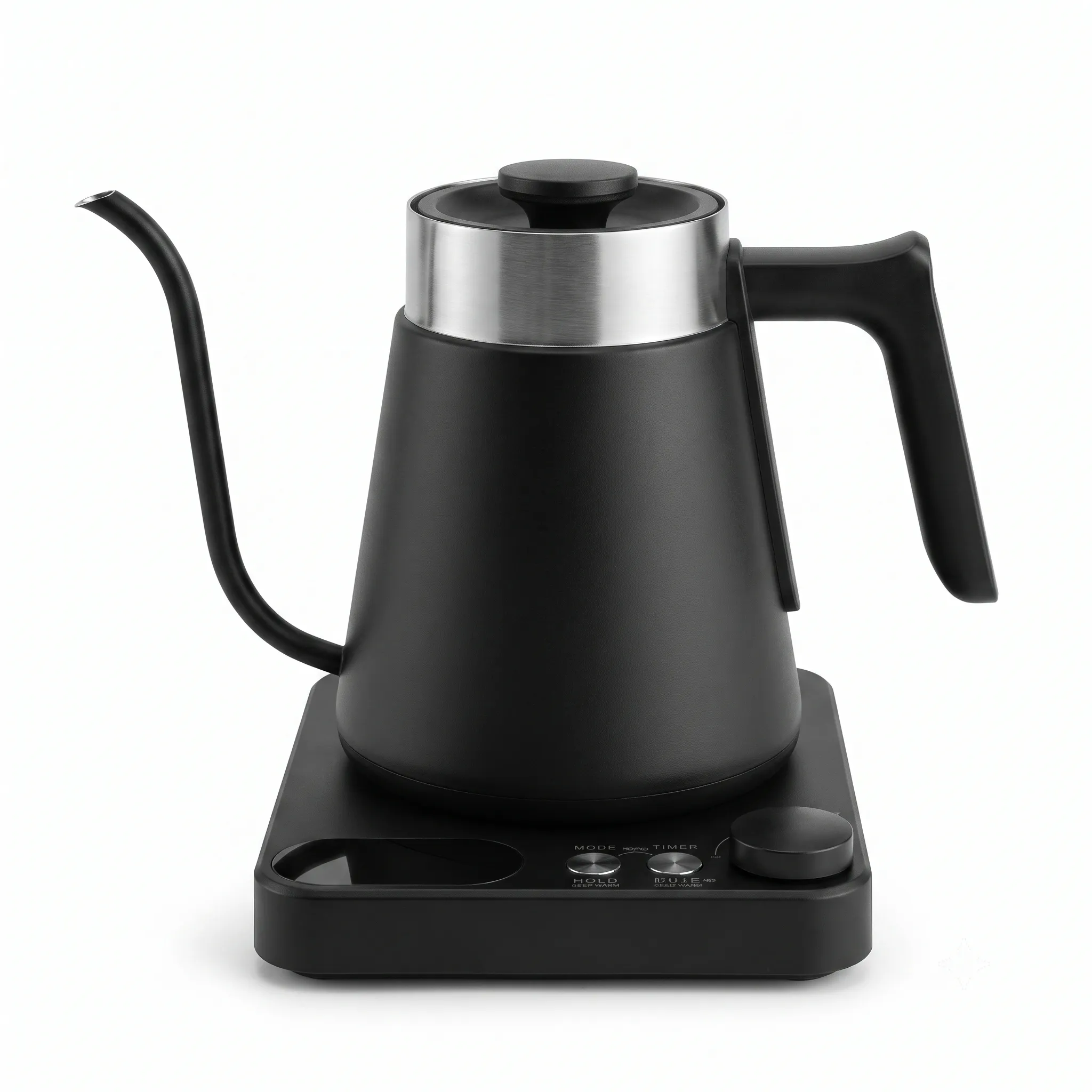
The beauty of pour-over coffee lies in using simple equipment to brew a cup that suits your personal taste. By mastering water temperature, flow rate, coffee-to-water ratio and extraction time, you can easily make a great cup at home. A gooseneck kettle with stable temperature control and a precise pour makes the whole process feel more effortless — which is why pour-over has become one of the fastest-growing brewing methods in cafés and homes alike.
Start by weighing 15 grams of coffee beans and 240 grams of water. Prepare a dripper, paper filter, digital scale and gooseneck kettle. Grind the beans to a texture similar to fine granulated sugar — a coffee-to-water ratio of about 1:16 is a good starting point.
Water temperature should match the roast level: light roasts around 92 °C, medium roasts around 90 °C, and dark roasts around 88 °C. With a temperature-controlled kettle, you can set the target temperature directly, reducing repeated checks and unnecessary waiting. When filling the kettle, keep the water above the minimum water-level mark.
Rinse the Filter
Place the paper filter in the dripper and rinse it evenly with hot water. This removes any papery taste while preheating the dripper and the serving carafe, preventing the coffee from cooling too quickly during brewing. Discard the rinse water, add the ground coffee, and gently shake the dripper to level the coffee bed.
Bloom the Coffee
Begin pouring slowly from the center of the coffee bed, gradually moving outward in small circles. Add about 30 grams of water — just enough to saturate all the grounds evenly — then let the coffee bloom for about 30 seconds so trapped gases can escape. If the coffee bed rises slightly and small bubbles appear, the beans are usually relatively fresh.
Pour in Stages
After the bloom, pour again in slow circular motions from the center outward, avoiding pouring directly onto the paper filter. Pour until the scale reaches 120 grams, let the water level drop slightly, then continue until the total reaches 240 grams. A slender gooseneck spout makes it easier to control the position and speed of the water. Keep the stream fine and steady — the entire brew should take about two to three minutes.
Adjust to Taste
Once the coffee has finished dripping, gently swirl the carafe before tasting. If it tastes too bitter or astringent, use a slightly coarser grind or lower the water temperature. If it tastes too sour or weak, use a finer grind or slightly hotter water.
Built for Cafés
For café owners preparing multiple orders in succession, the 1-liter capacity, adjustable temperature control and keep-warm function provide enough hot water for roughly three to four pour-overs without reheating for every brew. The precision gooseneck spout helps maintain a steady pouring rhythm, and returning the kettle to its base within 10 minutes resumes the previous setting for a smoother workflow. As the direct manufacturer, we also offer flexible customization — colors, branding and packaging — to suit different business and brand requirements.
If you are a café, hotel group, distributor or brand looking for a reliable pour-over kettle OEM factory in China, contact our export team at catherine_chen@zstianmao.cn or submit a sample request through our contact page. We support MOQ 1000, custom colors, custom logos, retail boxes and multilingual manuals.